
Commercial buildings in Pakistan face punishing summers, monsoon humidity, and some of the highest electricity tariffs in the region. A plaza in Sialkot, a mall in Lahore, or a hotel in Rawalpindi can lose tenants, customers, and profit when cooling fails. That is why owners want to know the full cost before they commit.
This guide explains what shapes a centralized air conditioning system price, how different system types compare, and how to plan for malls, plazas, kitchens, and mixed-use projects. You will also learn how to read a quotation, spot hidden costs, and cut running costs from day one.
Quick answer: There is no single fixed price for central AC in Pakistan. Cost depends on cooling capacity (tonnage), system type (ducted split, VRF, or chiller), equipment brand, ductwork, fresh air and filtration needs, controls, and installation scope. Ducted splits usually cost the least upfront. VRF sits in the middle. Chiller plants cost the most but suit very large buildings. The AC Hub offers free site surveys and itemized quotations across Sialkot, Lahore, Islamabad, and Rawalpindi. Call 0300-1234545.
Definition: A centralized air conditioning system cools, heats, filters, and circulates air through an entire building from one main plant or outdoor system. It delivers conditioned air through ducts, refrigerant piping, or chilled water lines instead of using separate wall-mounted units in every room.
A typical commercial setup includes:
Central systems give you even temperatures, cleaner facades, quieter spaces, and better energy control than dozens of separate split units.
Many buyers ask for a quick per-ton rate. In practice, two buildings of the same size can need very different budgets. The final figure depends on these factors:
|
Cost Factor |
What It Covers |
Impact on Budget |
|---|---|---|
|
Cooling Capacity (Tonnage) |
Total heat load of the building |
High |
|
System Type |
Ducted split, VRF, or chiller plant |
High |
|
Brand and Efficiency |
Inverter models, premium brands, efficiency ratings |
Medium to high |
|
Ductwork and Insulation |
Fabrication, sealing, insulation, diffusers |
Medium |
|
Piping |
Copper refrigerant lines or chilled water pipes |
Medium |
|
Fresh Air and Filtration |
Fresh air units, HEPA filters, exhaust fans |
Medium to high |
|
Electrical and Controls |
Panels, cabling, thermostats, BMS integration |
Low to medium |
|
Installation and Commissioning |
Labor, testing, balancing, handover |
Medium |
|
Exchange Rates and Duties |
Imported equipment costs |
Variable |
|
Maintenance Contract |
Scheduled service and spare parts |
Ongoing |
Since most commercial HVAC equipment is imported, rupee exchange rates and import duties can shift equipment costs from one quarter to the next. A quotation older than a few weeks may already be out of date.
Takeaway: Tonnage and system type drive most of the budget. Ductwork, filtration, and controls decide whether the system actually performs.
This comparison shows how the main options stack up for commercial buildings in Pakistan.
|
System Type |
Best For |
Relative Upfront Cost |
Running Cost |
Typical Lifespan |
Key Strength |
|---|---|---|---|---|---|
|
Ducted Split |
Small offices, shops, restaurants |
Low to moderate |
Moderate |
10–15 years |
Simple, affordable, hidden indoor units |
|
VRF / VRV |
Plazas, offices, hotels, clinics |
Moderate to high |
Low to moderate |
15–20 years |
Zone control and inverter efficiency |
|
Packaged Rooftop Unit |
Warehouses, single-floor retail |
Moderate |
Moderate |
15–20 years |
Saves indoor space |
|
Air-Cooled Chiller + AHUs |
Malls, hospitals, large hotels |
High |
Moderate |
20–25 years |
Handles large, steady loads |
|
Water-Cooled Chiller + AHUs |
Very large complexes, industrial sites |
Very high |
Low |
20–30 years |
Highest efficiency at scale |
A lower upfront price does not always mean a lower total cost. VRF and chillers often cost more at the start but save more on electricity over 15 to 20 years.
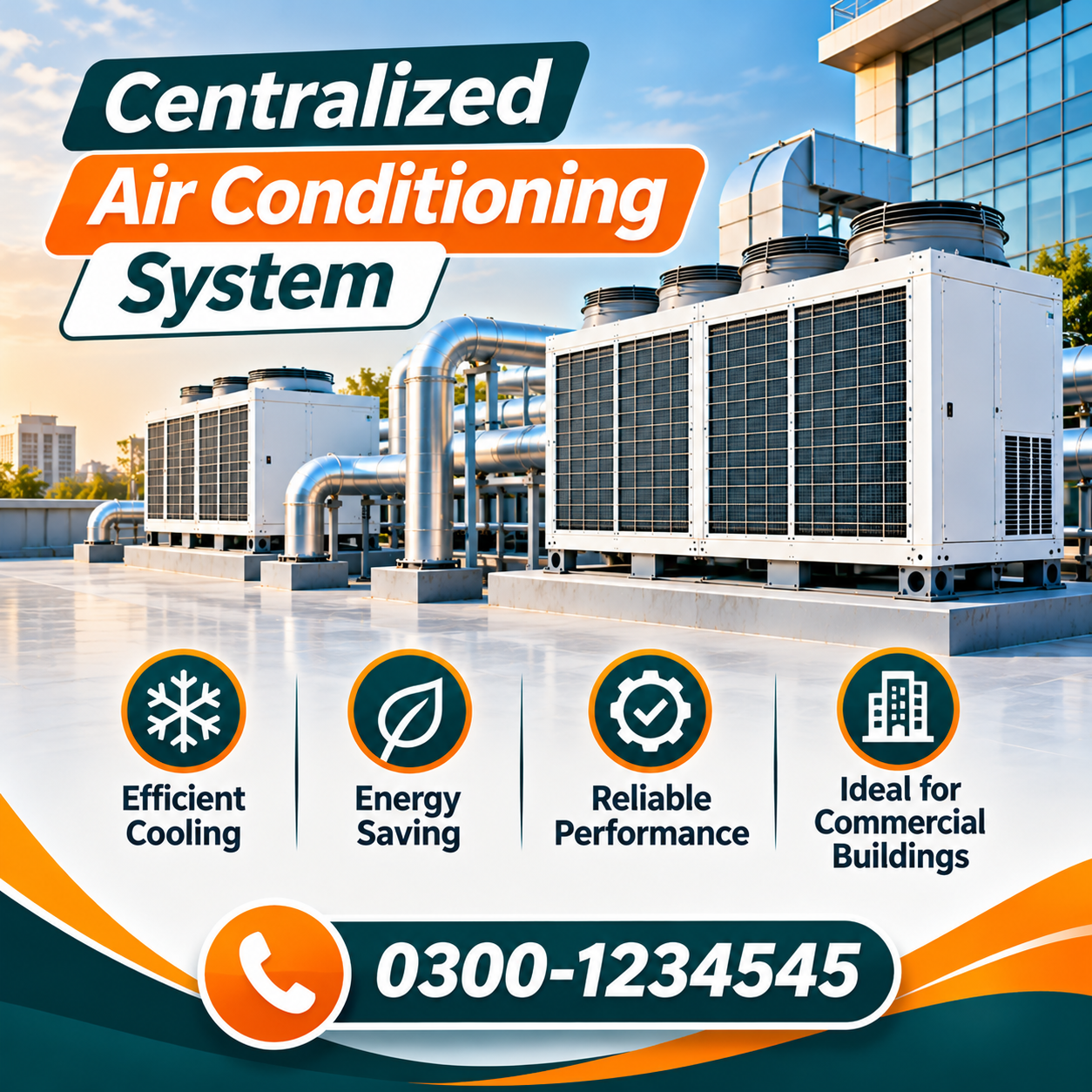
Retail buildings have unique cooling needs. Crowds rise sharply on weekends and during Eid shopping. Atriums, glass storefronts, food courts, and escalator voids add heavy heat loads. Individual shops also want control over their own space and their own electricity bills.
A well-planned central cooling system for plazas and malls usually combines:
For mid-size plazas with many separate shops and offices, VRF often gives the best balance of cost, control, and billing. For large malls with constant crowds and long hours, a chiller plant usually delivers better efficiency at scale. Choosing the right central cooling system for plazas and malls at the design stage prevents costly retrofits later.
Takeaway: Plan for tenant metering and peak crowds from the start. These two factors shape both system choice and long-term profitability.
Temperature is only one part of comfort. Pakistan’s monsoon brings heavy humidity, winters in the north need steady heating, and smog season in Lahore pushes indoor air quality to the top of the list. A climate control hvac system for commercial projects Pakistan businesses rely on must manage all of these at once.
Key elements include:
When you plan a climate control hvac system for commercial projects Pakistan wide, ask your contractor how the design handles moisture and air quality, not just temperature.
Sialkot is a major export hub, with manufacturing units, warehouses, offices, showrooms, and growing commercial plazas. Summers are hot and humid, and many facilities run long shifts. Buildings here often mix production floors, offices, and storage under one roof.
Businesses that centralize hvac system design in Sialkot gain clear advantages:
Industrial zones in Sialkot also face dust and voltage fluctuations. Good designs include stronger filtration and voltage protection for sensitive equipment.
Takeaway: A single, well-engineered design beats a patchwork of units added over time. It saves energy, simplifies service, and protects products.
Restaurants, hotel kitchens, food courts, and catering units generate intense heat, smoke, grease, and steam. A commercial kitchen hvac and ventilation system Pakistan food businesses depend on must protect staff, reduce fire risk, and keep cooking smells out of dining areas.
|
Kitchen Component |
Purpose |
Recommended Solution |
|---|---|---|
|
Exhaust Hoods |
Capture smoke, heat, and grease at the source |
Properly sized hoods with baffle grease filters |
|
Exhaust Fans |
Push contaminated air outside |
Heat-rated fans with easy-clean access |
|
Make-Up Air Units |
Replace air removed by exhaust |
Tempered fresh air supply |
|
Pressure Balance |
Stop smells drifting into dining areas |
Kitchen held at slight negative pressure |
|
Odor Control |
Protect neighbors and nearby tenants |
Carbon filters or electrostatic precipitators |
|
Spot Cooling |
Keep cooks comfortable on the line |
Directed supply air above work areas |
Without make-up air, doors become hard to open, hoods lose performance, and smells spread through the building. In malls and plazas, kitchen exhaust must also align with the building’s fire safety plan. Planning a commercial kitchen hvac and ventilation system Pakistan restaurants can depend on means treating the kitchen and dining area as two linked systems.
A clear process protects your budget and your timeline. Professional projects follow these stages:
Plan HVAC during construction, before false ceilings close. Late planning leads to exposed ducts, rework, and higher costs.
- Central AC cost depends on tonnage, system type, brand, ductwork, filtration, and installation scope.
- Ducted splits cost least upfront, VRF suits multi-zone buildings, and chillers suit large malls and complexes.
- Retail buildings need tenant metering, fresh air, and capacity for peak crowds.
- Humidity control, heating, and filtration matter as much as cooling in Pakistan.
- Sialkot facilities benefit from one coordinated design across offices, production, and storage.
- Commercial kitchens need hoods, exhaust, make-up air, and pressure balance.
- Always ask for a site survey, written heat load report, and itemized quotation.
There is no fixed rate per ton. Cost varies by system type, brand, ductwork length, filtration, controls, and exchange rates. Ducted splits are usually the lowest per ton, followed by VRF, then chillers. A site survey gives the most accurate figure.
VRF suits mid-size plazas with many separate shops and offices because it offers zone control and easy tenant billing. Large malls with constant crowds usually benefit more from chillers with air handling units.
It should control temperature, humidity, fresh air, and filtration together. Heat pump capability for winter, smart controls, and stronger filters for smog and dust are also important.
One coordinated design lowers energy use, simplifies maintenance, protects products with stable conditions, and allows the system to expand as your business grows.
It includes exhaust hoods with grease filters, exhaust fans, make-up air units, pressure balancing, odor control, and comfort cooling for kitchen staff.
VRF usually costs less upfront for small and mid-size buildings. Chillers cost more at the start but often run more efficiently in very large buildings with steady demand.
Small offices and restaurants often take one to three weeks after design approval. Malls, plazas, and large complexes can take several weeks or months, depending on scope.
The AC Hub serves commercial clients in Sialkot, Lahore, Islamabad, and Rawalpindi.
The right central system keeps customers comfortable, protects your property, and controls energy bills for years. An accurate centralized air conditioning system price comes from a real site survey, a written heat load calculation, and an itemized quotation, not a rough phone estimate.
The AC Hub designs, supplies, installs, and maintains central HVAC systems for plazas, malls, offices, factories, hotels, and commercial kitchens across Sialkot, Lahore, Islamabad, and Rawalpindi. Share your floor plans or project details, and our engineers will prepare a clear, line-by-line proposal.
Call The AC Hub at 0300-1234545 to book your free site survey today.