
A factory floor climate control HVAC system does much more than keep workers cool. In a Pakistani summer, production halls can climb well above outdoor temperatures because of machine heat, roof exposure and long shifts. That heat slows workers, stresses equipment and can affect product quality.
Many plants still rely on a few wall-mounted splits or exhaust fans and hope for the best. The result is usually high electricity bills, frequent breakdowns and hot spots that never cool down. This guide explains how to plan industrial cooling properly, which equipment suits which space, what drives cost and how to choose a supplier.
It comes from The AC Hub, a Lahore-based HVAC company and certified official 3S authorized dealer. We serve residential, commercial and industrial clients across Pakistan.
Quick answer: Factory cooling in Pakistan works best when it starts with a site survey and a written heat load calculation. Large production halls usually suit floor standing commercial units, package units or ceiling exposed (RCM) units. Offices, QC labs and control rooms inside the plant suit inverter splits or cassettes. Choose high-ambient (T3) models with three-phase power protection, easy-access filters and written warranty support from an authorized dealer.
Key takeaways:
It’s an engineered setup that controls the indoor conditions of a production space. A well-designed system manages four things:
Household and light office ACs are built for small rooms with steady loads. A production floor is different. It has high roofs, open doors, constant machine heat and dust in the air. Small units run at full load all day, clog quickly and wear out early.
Industrial spaces need equipment designed for long running hours, high capacity and tough outdoor conditions.
Summary: Proper climate control protects people, products and machines at the same time.
Good factory cooling starts on paper, not on the roof. Following a clear process saves money and avoids rework.
Rule-of-thumb sizing, such as “one ton per so many square feet,” ignores the factors that matter most in a plant. A better approach looks like this:
An undersized system struggles on hot afternoons. An oversized one wastes electricity and controls humidity poorly. Correct sizing protects both comfort and running costs.
Very tall halls don’t always need the whole volume cooled. Spot cooling directs conditioned air to workstations, assembly lines or packing areas. This can cut capacity needs and running costs. Full-hall cooling makes more sense where products, materials or machines need stable conditions throughout.
The right equipment depends on the space, the process and the budget. A Heavy duty HVAC unit for factories should handle high capacity, long operating hours and high outdoor temperatures without frequent faults.
The table below compares common hvac units for industrial use available in Pakistan.
|
System Type |
Typical Capacity Range |
Installation |
Best Fit in a Factory |
Key Advantage |
|---|---|---|---|---|
|
Floor standing commercial unit |
2 to 8 ton |
On the floor, with outdoor unit |
Production halls, assembly lines, workshops |
High capacity, easy to service |
|
Package unit |
Project-based |
Rooftop or ground pad, ducted |
Large ducted halls, stores, packing areas |
Central cooling with minimal indoor space |
|
Ceiling exposed (RCM) unit |
2 to 4 ton |
Surface-mounted on ceiling |
High-roof areas without false ceilings |
Saves floor space |
|
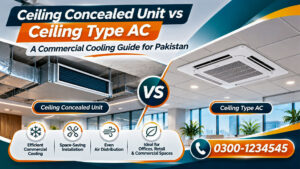
Concealed duct unit |
2 to 3.8 ton |
Above false ceiling with ducts |
Admin blocks, buyer showrooms |
Clean interior look |
|
Ceiling cassette |
2 to 3.8 ton |
Recessed in false ceiling |
QC labs, design rooms, offices |
Even, quiet airflow |
|
Inverter split |
1 to 2 ton |
Wall-mounted |
Control rooms, cabins, guard rooms |
Low running cost at part load |
|
VRF/VRV |
Project-based |
Shared outdoor units, many indoor units |
Multi-room office blocks within the plant |
Room-by-room control |
|
Exhaust and fresh air system |
Project-based |
Roof or wall-mounted |
Finishing, grinding, welding and paint areas |
Removes fumes, dust and heat |
The AC Hub’s range includes options such as TCL 4 ton and 8 ton inverter floor standing commercial units, Acson 8 ton dual-circuit floor standing units and Midea 4 ton ceiling exposed units. These suit many medium and large production spaces.
Sahiwal and the surrounding district host flour mills, rice mills, feed mills, dairy and food processing units, cotton ginning and agro-industries. These sites share a few common pressures:
A well-planned factory floor climate control HVAC system Sahiwal plants can rely on usually combines floor standing or package units for halls, ceiling exposed units for high-roof stores and inverter splits for labs and offices. Food areas also benefit from planned fresh air, filtration and sealed drain lines.
Pre-season servicing is just as important as equipment choice. Cleaning coils and checking electrical connections before each processing season prevents breakdowns at the busiest time of year.
Many buyers search for Industrial HVAC system manufacturers and assume buying direct is always better. In practice, most global brands sell, install and support their products in Pakistan through authorized dealers.
Working with an authorized dealer gives you several practical benefits:
The leading Industrial HVAC system manufacturers each have strengths in different capacities and product types. A good dealer helps you choose based on your building, not on a single brand they need to sell.
There’s no fixed price for factory cooling, because every plant is different. These are the main cost drivers:
When comparing quotes, match the capacity, model numbers, inclusions and warranty terms. Two quotes for the same tonnage can look very different once installation scope is added.
Regular care keeps cooling strong and extends equipment life:
The AC Hub provides air conditioning and climate control solutions for homes, businesses and industrial sites across Pakistan.
Our corporate team supplies cooling for industries, offices, shopping malls, restaurants, gyms, high-rise buildings, plazas, wedding halls and marquees. Because we offer split, cassette, concealed duct, floor standing, ceiling exposed, package and multi-zone systems, you get advice based on your plant.
Most mills combine floor standing or package units for production halls, ceiling exposed units for high-roof stores and inverter splits for offices and labs. Choose T3-rated models and plan regular filter cleaning for dust and chaff.
Most global brands sell and support products in Pakistan through authorized dealers. Buying through an authorized dealer gives you genuine equipment, valid warranties, original spare parts and local installation support.
Floor standing commercial units commonly range from 2 to 8 ton, while package units are sized per project. The right capacity depends on a written heat load calculation for each zone.
Floor standing, package and ceiling exposed units with easy-access filters and coils perform well. Regular cleaning and pre-season servicing are essential in dusty or lint-heavy environments.
Usually, yes, for plants with changing loads across shifts. Inverter compressors adjust output to match demand, which can lower electricity bills over time.
Yes. The AC Hub offers nationwide delivery across Pakistan, along with installation and warranty support.
The right factory floor climate control HVAC system keeps workers productive, products consistent and machines running through Pakistan’s hardest summers. Success comes from careful sizing, the right mix of equipment, genuine products and dependable after-sales support.
Talk to The AC Hub today. Call 0321-7227838 or WhatsApp 0300-1234545 for a site survey and project quote. You can also visit our office at Mezzanine Floor, Office No. 13 & 14, Bara Tower, Qartaba Chowk, Mozang Chungi, Lahore.